
How to Protect Pine Trees from Mountain Pine Beetles in Castle Rock, Colorado
Protect Your Trees Before Beetles Strike
Mountain pine beetles are increasing again across Colorado, and many areas along the Front Range — including Douglas County and Castle Rock — are seeing elevated activity. If you have pine trees on your property, early prevention and inspections are the best way to protect them.
SprayTech provides professional pine beetle treatment in Douglas County to help homeowners protect ponderosa and other pine trees from mountain pine beetle infestations.
📞 Call SprayTech today: 720-248-0000
You can also submit a request for an estimate directly through the form on our website, and a member of our team will reach out to schedule a treatment.
What Are Mountain Pine Beetles?
The mountain pine beetle (Dendroctonus ponderosae) is a bark beetle native to the forests of western North America. Under normal conditions, these insects play an important ecological role. They typically attack weakened or diseased trees, helping thin forests and make space for new growth.
However, when forests become overly dense and stressed by drought or warmer temperatures, beetle populations can expand rapidly. In these conditions, the insects begin attacking healthy trees, leading to widespread pine beetle infestations in Colorado forests.
The beetle’s life cycle usually lasts one year. Adult beetles typically fly from tree to tree in mid-summer — most commonly between July and August — seeking new host trees to infest. Female beetles burrow through the bark and lay eggs inside the tree. Once the larvae hatch, they feed beneath the bark, cutting off the tree’s ability to transport water and nutrients. Over time, this causes the tree to die.
Colorado’s Past Pine Beetle Epidemic
Colorado has already experienced one of the largest mountain pine beetle outbreaks in North American history.
From the late 1990s through 2013, mountain pine beetles affected approximately 3.4 million acres of forest across Colorado. In some areas of the state — particularly in Summit, Grand, Eagle, and Routt counties — up to 80–90% of lodgepole pine trees were killed.
During the early 2010s, the insects began spreading from higher-elevation lodgepole forests into ponderosa pine forests along the Front Range, where many homes and communities are located. While heavy rains eventually slowed the outbreak, many forests remain vulnerable today.
Mountain Pine Beetle Activity in Douglas County, Colorado
Recent weather patterns — including warmer temperatures and drought stress — have created ideal conditions for mountain pine beetle activity in Douglas County and the Front Range.
Foresters have reported elevated levels of infestation in several counties, including:
Larimer County
Gilpin County
Clear Creek County
Boulder County
Jefferson County
Park County
Douglas County
Because ponderosa pine trees are the most common trees in Douglas County, the risk to residential properties is significant. These trees are highly susceptible to pine beetle infestations, especially during large outbreaks.
Local arborists have reported seeing more pine tree beetle damage across the Front Range, including neighborhoods around Castle Rock, Parker, and Highlands Ranch.
Why Pine Beetles Are a Concern for Douglas County Homeowners
For many homeowners, pine trees are one of the most valuable parts of their landscape. Unfortunately, mountain pine beetles can attack even healthy trees during large outbreaks.
In addition to killing trees, beetle infestations can also lead to:
Increased wildfire risk due to dead trees
Reduced property value and curb appeal
Impacts to wildlife habitat and water quality
Greater tree removal costs if infestations spread
Because of these risks, many property owners are now exploring preventative pine beetle treatment in Douglas County to protect valuable trees.
Signs of a Mountain Pine Beetle Infestation
Early detection is critical when dealing with pine beetles in Colorado. Trees may look healthy for months after infestation before visible symptoms appear.
Watch for these warning signs:
Pitch tubes: Small popcorn-shaped masses of resin on the trun
k. These may appear white, pink, or brown as the tree tries to push the beetles out.
Boring dust (frass): Fine sawdust that collects in bark crevices or around the base of the tree.
Woodpecker activity: Woodpeckers often strip bark from inf
ested trees while feeding on beetle larvae.
Exit holes: Small holes in the bark where adult beetles emerge.
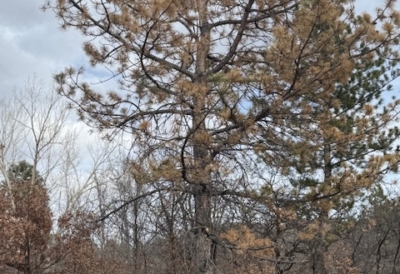
Needle discoloration: The tree’s needles eventually turn yellow and then reddish-brown. This often happens 8–10 months after infestation, which means the tree is usually already dead.
How to Prevent Pine Beetle Infestations
While large outbreaks can be difficult to stop, homeowners can take several steps to protect pine trees from beetles in Colorado.
-Preventative Pine Beetle Treatment
Preventative treatments are one of the most effective ways to protect
high-value trees.
-Improve Tree Health
Healthy trees are more resistant to insect attacks. Property owners can help by:
Deep watering during dry periods
Applying mulch around the base of the tree
Avoiding damage to tree roots
Maintaining proper spacing between trees
-Remove Infested Trees
Once a tree has been successfully attacked by mountain pine beetles, it is usually too late to save it. Removing the tree quickly can help prevent the infestation from spreading to nearby trees.
Community Cooperation Matters
Managing mountain pine beetles in Douglas County requires cooperation between homeowners, HOAs, and land managers. Beetles easily spread from one property to a
nother.
If one homeowner treats their trees but neighboring properties ignore infestations, the problem can quickly return.
This is why forestry experts recommend community-wide pine beetle prevention efforts throughout the Front Range.
Looking Ahead: Protecting Colorado’s Pine Forests
Mountain pine beetles are a natural part of Colorado’s forest ecosystem.
However, drought conditions, warmer temperatures, and dense forests can cause beetle populations to grow rapidly.
The goal is not to eliminate beetles completely but to create healthier, more resilient forests and landscapes. Through early detection and preventative pine beetle treatment, homeowners can help reduce the impact of future outbreaks.
Schedule a Pine Beetle Inspection for Your Trees
If you live in Douglas County, Castle Rock, Parker, or surrounding Front Range communities, it’s important to monitor your pine trees for early signs of infestation.
SprayTech provides professional pine beetle treatment and preventative tree care in Douglas County, Colorado. Our team can inspect your trees, identify early warning signs, and recommend the best treatment plan to protect your landscape.
📞 Call SprayTech today: 720-248-0000
You can also submit a request through the form on our website, and our team will contact you to schedule a tree inspection.
Protect your trees early — prevention is the most effective way to stop mountain pine beetles in Colorado before they cause serious damage.

Comments are closed.